 Clearwater Siding
 Clearwater's Climate Is Not Gentle on Siding
Homeowners in Pinellas County sometimes ask why we don't offer a menu of siding brands the way some contractors do. The honest answer is that we've spent years watching how different siding materials actually perform on Gulf Coast homes, not just how they look on a sample board in a showroom. Clearwater sits in a corridor that sees hurricane-force wind events, wind-driven rain that gets forced sideways into wall assemblies, near-constant UV exposure, and salt-laden air rolling in off the water. Any siding product installed here is going to be tested by all four of those conditions, often in the same week.
That combination is harder on exterior materials than most inland climates. UV breaks down pigments and surface coatings faster. Salt air accelerates corrosion of fasteners and trim metal. Wind-driven rain finds every gap in flashing and lap joints. And storm winds put direct load on how well the material is fastened and how well it holds its shape when soaked. We made a decision a long time ago to stop installing anything we weren't fully confident would hold up to that combination, and that decision is why James Hardie fiber cement is the only siding system on our trucks.
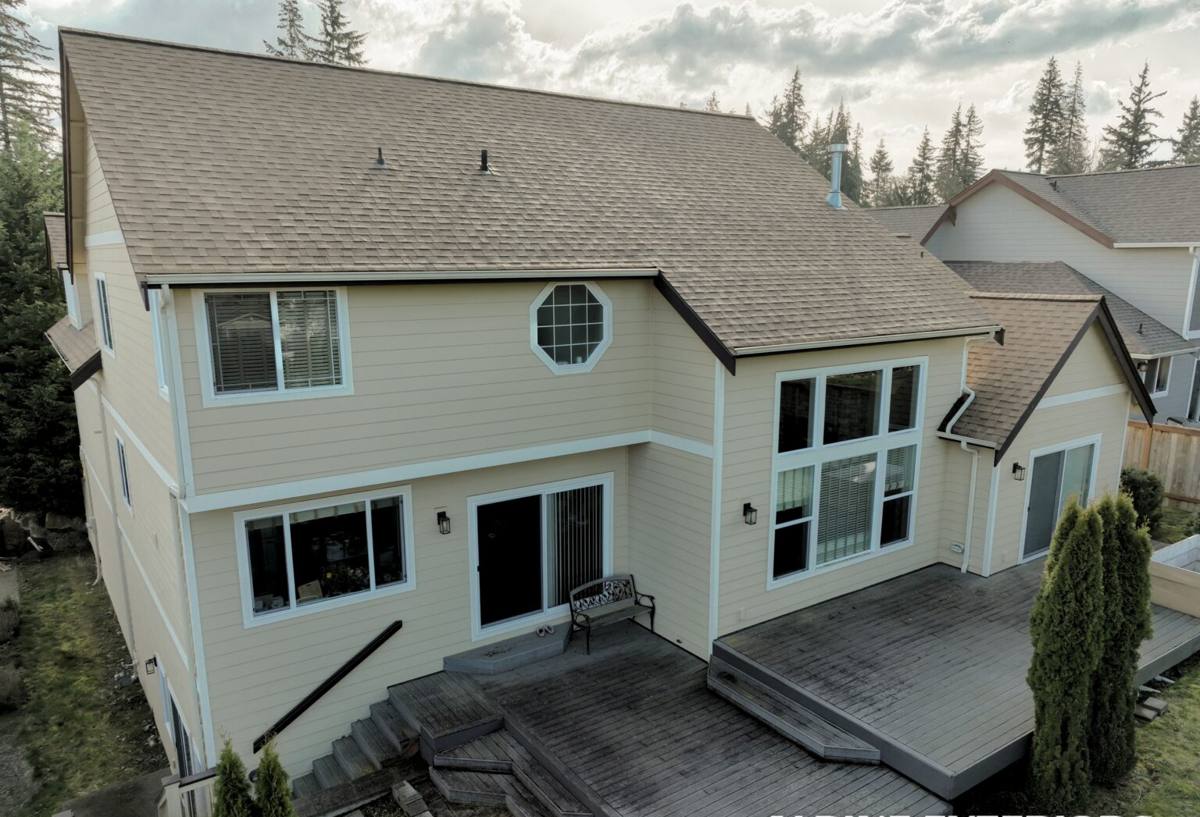
What Fiber Cement Actually Is
James Hardie siding is made from a mix of Portland cement, sand, and cellulose fiber, cured into rigid boards and panels. It's not plastic, it's not wood, and it's not a wood composite. That matters in a coastal climate because fiber cement doesn't absorb water the way wood-based products can, doesn't soften or rot, and doesn't warp or expand and contract with humidity swings the way vinyl and untreated wood do.
Non-Combustible
Fiber cement is non-combustible, which is a real, measurable property, not a marketing line. It won't contribute fuel to a fire the way wood siding or many polymer-based sidings can. For homeowners in wooded parts of Pinellas County or those who simply want one less flammable material on the exterior of their home, that's a meaningful, practical advantage.
Dimensional Stability
Because it's cement-based, Hardie board doesn't expand and contract with temperature and humidity the way vinyl or wood products do. In a climate that swings from humid, wet summers to drier winter stretches, that stability keeps joints tighter, paint lines cleaner, and fastener holes from working loose over time.
The HZ5 Climate-Engineered Product Line
James Hardie doesn't make one generic product for the whole country. They engineer regional formulations, and the HZ5 line is built specifically for high-humidity, high-moisture climates like Florida's Gulf Coast. This isn't a superficial regional label — the formulation and moisture-management engineering are tuned for exactly the conditions Clearwater homes deal with every year.
Product Lines We Install
- HardiePlank lap siding — the most common horizontal lap profile, available in several textures and exposures
- HardiePanel vertical siding — for board-and-batten or modern vertical looks
- HardieShingle — staggered or straight-edge shingle profiles for coastal cottage and craftsman styles
- HardieTrim boards — corner boards, fascia, and window/door trim that match the field siding's durability
- HardieSoffit panels — vented and non-vented options for eave and porch ceilings
Each of these is available with different textures (smooth, cedarmill, beaded) so the finished look can range from a clean modern flat panel to a traditional wood-grain lap, without giving up the underlying material's performance.
ColorPlus Technology: Why the Finish Matters as Much as the Board
A siding board is only as good as the finish protecting it, and this is where a lot of the real-world difference shows up. James Hardie's ColorPlus finish is baked on in a factory using a multi-coat process under controlled conditions, then cured before the boards ever reach a job site. That's a fundamentally different process than a painter rolling or spraying finish coats onto siding in the field, at the mercy of humidity, temperature, and dust on installation day.
What This Means for a Clearwater Home
A factory-applied, baked-on finish resists the fading that intense year-round Florida UV causes to field-applied paint. It also resists color inconsistency from batch to batch, and it comes backed by its own finish warranty separate from the substrate warranty. Homeowners who choose primed fiber cement or bare wood products and paint them on site are taking on that UV-fade and touch-up burden themselves, often within just a few years in this sun.
Why We Refuse to Install Certain Alternatives
We get asked from time to time about vinyl siding, LP SmartSide, primed spruce, cedar, and other fiber cement brands like Cemplank or Allura. We don't install any of them, and we think homeowners deserve an honest explanation rather than a sales pitch. This isn't about disparaging any single manufacturer — it's about what we've decided we're willing to put our name behind after seeing how these materials age on real Gulf Coast homes.
| Material | Common Trade-Off in This Climate |
|---|---|
| Vinyl siding | Can soften, warp, or become brittle under sustained heat and UV; seams and panels can be vulnerable in high sustained wind events |
| LP SmartSide (wood strand) | Engineered wood core is more moisture-sensitive at cut edges and fastener penetrations; requires disciplined field sealing to avoid swelling |
| Primed spruce / raw wood | Needs ongoing paint maintenance and is naturally more prone to moisture absorption and rot in humid coastal air |
| Cedar siding | Attractive but combustible, and requires regular refinishing to hold up against UV and salt air |
| Other fiber cement brands | May lack a climate-specific HZ formulation and factory finish system matched to Gulf Coast humidity and UV |
| James Hardie HZ5 + ColorPlus | Cement-based, non-combustible, factory-cured finish engineered for high-humidity coastal regions |
Every one of these alternative products has a place somewhere, and some perform reasonably well in drier, milder climates. Our decision is specific to what we've seen happen — and not happen — to homes exposed to Pinellas County's particular mix of salt air, sun, and storms.
Installation Is Where Siding Performance Is Actually Won or Lost
James Hardie itself is clear that its products only perform to spec when installed to its published installation instructions — clearances, fastener patterns, flashing details, and caulking all matter. A great board installed poorly will still fail early. This is a big part of why "who installs it" matters as much as "what brand you chose."
What Correct Installation Involves
- Proper starter strip and minimum ground clearance to keep boards away from splash-back moisture
- Correct fastener type, spacing, and embedment depth per Hardie's published specs
- Weather-resistant barrier and flashing integrated correctly at windows, doors, and penetrations
- Proper joint treatment and caulking at butt joints and trim intersections
- Factory-cut or field-cut edges sealed per manufacturer guidance where required
- Adequate clearance at roof lines, decks, and other abutting surfaces to allow drainage
We install to these specs on every job, not as an upsell, but because it's the only way the product performs and the warranty stays intact.
The Warranty, and Why Transferability Matters
James Hardie backs its siding products with a long-term limited warranty, and ColorPlus finishes carry their own separate finish warranty. One detail homeowners often overlook: Hardie's warranty is transferable to a subsequent homeowner if the home is sold, which is a real asset when it comes time to sell a house in a competitive coastal market like Clearwater. A documented, transferable warranty on the exterior envelope is something buyers and their inspectors notice.
Warranty coverage assumes installation according to manufacturer specifications, which is another reason correct installation isn't optional — it's what keeps the homeowner's warranty valid if something ever needs to be addressed down the line.
What This Costs, and What Drives the Range
We don't publish fixed prices because every home's siding scope is different, but the factors below are what actually move the number on a Clearwater project.
| Cost Factor | Why It Matters |
|---|---|
| Home size and wall complexity | More corners, dormers, and cut-ins mean more labor and trim work |
| Existing siding removal | Tear-off of old siding and any sheathing repair adds time and disposal cost |
| Product line and profile | Lap, panel, and shingle profiles carry different material and labor costs |
| Trim and accessory scope | Full HardieTrim and soffit packages cost more than field siding alone |
| Underlying moisture or wood damage | Rot or water intrusion found during tear-off requires repair before new siding goes on |
The most reliable way to get an accurate number is a walk-through of the specific home, not a generic per-square-foot quote pulled from a website.
Get a Straight Answer for Your Home
If you're weighing siding options for a home in Clearwater or elsewhere in Pinellas County, we're happy to walk your property, point out what your current siding is doing well or poorly, and explain exactly what a James Hardie system would involve for your specific home. Use the form below to request a free, no-pressure estimate.