 Clearwater Siding
 Board & Batten Siding for Countryside Homes
Countryside is one of the larger established residential pockets of Clearwater, and it's got the housing stock to match — decades of ranch-style, split-level, and traditional homes sitting on mature, tree-lined lots well inland from the beach. Board and batten has become a popular way to update that housing stock without changing its character: a vertical-plank accent on a gable, an entry surround, or a full wall gives an older home a cleaner, more current look without pretending it's something it isn't. It's a good fit for this neighborhood's mix of home ages and styles.
What board and batten isn't, though, is a purely cosmetic choice. It's a joint pattern — wide boards installed first, narrower battens fastened over every seam between them — and every one of those seams is a place where wind, rain, and UV get a crack at the wall. In Pinellas County, where hurricane-force winds, intense year-round sun, wind-driven rain, and salt air all take turns working on a home's exterior, how those seams are built matters as much as how they look. We install this style exclusively in James Hardie fiber cement, and every detail of a Countryside board and batten job gets built around what this specific climate does to a wall over ten, twenty, and thirty years.
What Countryside's Climate Puts a Board & Batten Wall Through
Hurricane-Force Wind Loads on Vertical Seams
Board and batten uses roughly double the fasteners of standard lap siding, because both the boards and the battens covering their seams need to be secured independently. In a wind event, every one of those fastener points is a load path, and a batten that's under-fastened, over-driven, or spaced wider than the manufacturer's spec is a weak point in a wall that otherwise looks identical to a correctly built one — right up until it isn't.
Year-Round UV and Field-Applied Finishes
Countryside doesn't get a real winter break from the sun the way most of the country does. Siding here takes a near-constant UV load twelve months a year, and any finish that isn't formulated to hold up under that gets chalky, faded, or brittle faster than homeowners expect. On board and batten, that shows up first at the battens themselves, since they carry more exposed edge per square foot than a flat wall does.
Wind-Driven Rain and Salt Air, Even This Far From the Beach
Countryside sits well inland from Clearwater Beach, but Pinellas County is a narrow peninsula, and salt-tinged air moves across all of it, not just the waterfront. It's a lighter dose than a Gulf-front home gets, but it's still enough to accelerate corrosion on exposed fasteners over the years. Combine that with the wind-driven rain that comes through during summer storms and tropical systems, and every seam on a board and batten wall is dealing with moisture pushed sideways, not just falling straight down.
Why We Install Board & Batten Only in James Hardie
Board and batten amplifies whatever weaknesses a siding material already has, because it has more seams and more exposed edge than a flat lap wall. That's the reason we don't offer this style in vinyl, primed spruce, cedar, LP SmartSide, Cemplank, or Allura. Those are legitimate products, and other contractors install them competently — we made a professional call that on a profile with this many joints, in a climate that stresses every one of them, standing behind one system we trust completely serves Countryside homeowners better than offering a cheaper alternative that quietly shifts maintenance risk onto them a few years down the road.
| Material | Behavior at Batten Seams | UV/Finish Durability | Realistic Upkeep |
|---|---|---|---|
| James Hardie fiber cement | Dimensionally stable; doesn't swell, cup, or gap at the joint | Factory-baked ColorPlus finish resists fading and chalking | Low — occasional rinse, no repaint cycle |
| Vinyl | Can warp or gap at battens under heat and thermal movement | Color fades and chalks under sustained Florida UV | Low, but hidden moisture behind seams is hard to catch |
| Cedar or primed wood | Absorbs moisture at every seam without regular sealing | Fully dependent on a repainting or resealing cycle | High — recurring maintenance to keep ahead of the climate |
| Engineered wood panels | More sensitive to moisture at cut edges and fastener holes | Moderate; edge sealing needs ongoing attention | Moderate to high, climate-dependent |
Fiber cement's core doesn't expand and contract with humidity the way wood-based products do, which is exactly the property that matters most on a profile built entirely out of vertical joints. Hardie's ColorPlus finish also means the only field-painted surfaces on the job are the cut edges we prime on site — not the whole wall, the way it works with materials that rely on paint as their primary weather barrier.
What a Correct Board & Batten Installation Looks Like
The finished look of board and batten is simple, but a correct install has a lot going on behind the surface that a homeowner never sees once the job is done:
- Weather-resistive barrier installed and correctly lapped before any siding goes up, not just stapled on and left alone
- A drainage gap behind the panels so any moisture that gets past the surface has somewhere to go besides sitting against the wall
- Corrosion-resistant fasteners set at the spacing James Hardie's installation spec calls for, sized for this wind zone
- Battens set with proper clearance rather than caulked tight, so the wall can shed water instead of trapping it at the seam
- Flashing correctly lapped at every window, door, corner, and base transition, where the vertical run meets a horizontal surface
- Field-cut edges primed before installation, since that's the one place the factory finish doesn't already cover
Skip any one of these steps and the wall can still look right for a season or two. The problems that come from skipping them — staining at the seams, soft spots near the base, finish failure along the battens — take a few wet seasons to show up, which is exactly why a corner-cutting install can get away with it until the homeowner is the one dealing with the consequences.
Where Board & Batten Fits on a Countryside Home
Most of the board and batten work we do in this neighborhood isn't a full-house replacement — it's used deliberately, on the parts of a home where the vertical lines do the most for the architecture:
- A front gable or dormer, which gives an otherwise flat elevation some real dimension from the street
- An entry surround or porch feature, drawing the eye to the front door
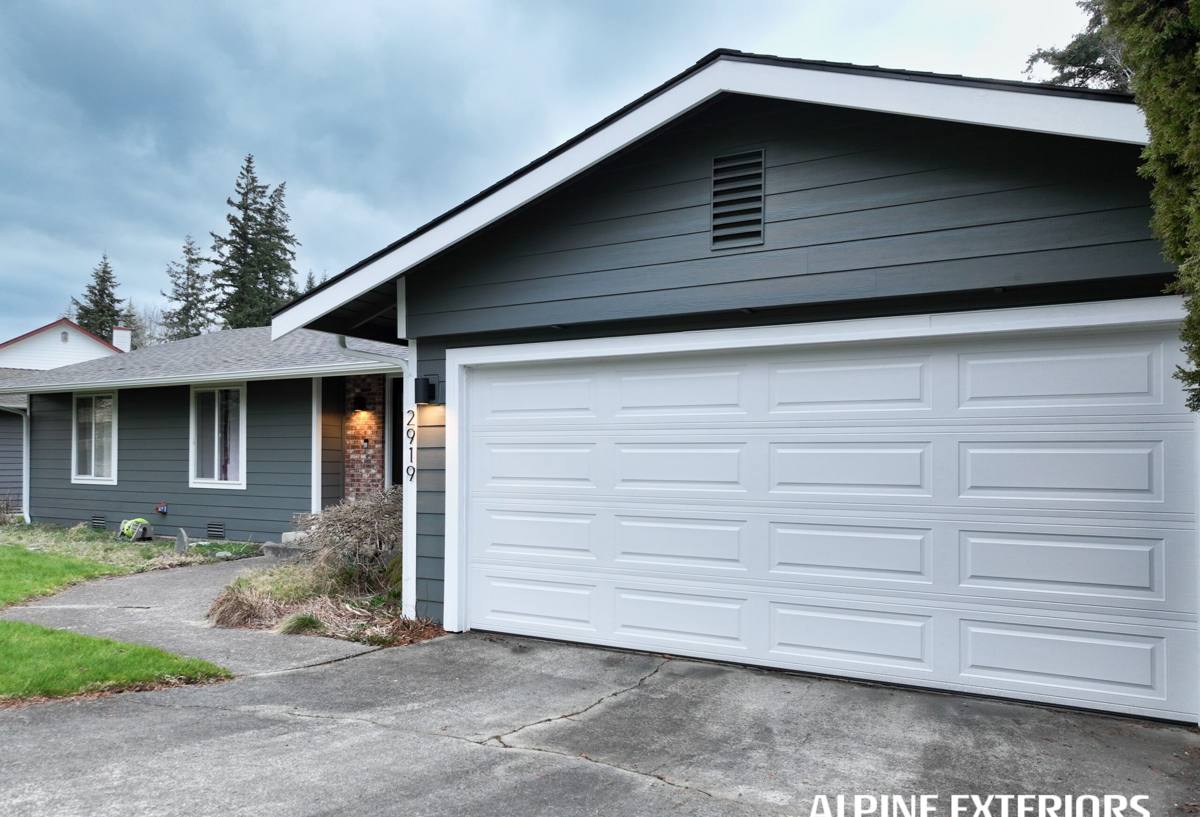
- A garage-facing wall, updating one of the most visually dominant parts of a ranch-style home
- A full accent wall paired with James Hardie lap siding everywhere else, which keeps material cost reasonable while still delivering the architectural detail
This approach is common across Countryside's mix of home styles, and it lets homeowners get the board and batten look without the cost of running it across every wall of the house. If your community has an HOA with exterior guidelines, we're used to working within those constraints and can talk through what's realistic before you commit to a design.
Our Process for a Countryside Project
Walkthrough and Wall-by-Wall Assessment
We look at each wall's exposure — which ones take direct sun and driving rain, which are shaded by mature trees and slower to dry, and whether the existing wall assembly has any hidden moisture or rot that needs addressing before new siding goes over it. Board and batten installed over an unresolved problem just hides it under new material for a while.
Planning the Seam and Batten Layout
Batten spacing, corner details, and how the siding meets windows, trim, and rooflines get worked out before crews start cutting material. On a profile with this many seams, planning those details on paper first keeps the crew from improvising in the field, which is usually where corners get cut.
Installation to Manufacturer Spec
Every fastener, gap, and flashing lap follows James Hardie's published installation requirements for our climate zone, not a generic national standard. That's what keeps the manufacturer's warranty intact, and it's why the wall is built to perform for decades rather than years.
Final Walkthrough
We walk the finished job with you, cover what little maintenance board and batten actually needs in this climate, and make sure you know what a healthy wall looks like if you ever want to check it yourself down the road.
Cost Factors for Board & Batten in Countryside
Board and batten generally costs more per square foot than standard lap siding, mostly because of the added batten material and the extra labor of fastening and detailing two layers instead of one. Beyond that base difference, a few things move the price on a specific Countryside home:
| Factor | Why It Matters |
|---|---|
| Home age and existing wall condition | Older homes may have rot, old fasteners, or moisture damage that needs repair before new siding goes up |
| Wall complexity | Gables, dormers, and multiple roof transitions mean more cuts and flashing details |
| Scope — accent vs. full wall | An entry surround or gable costs far less than running the profile across an entire elevation |
| Batten spacing and reveal | Tighter spacing uses more material and more fastening labor per square foot |
| Tree cover and site access | Mature landscaping common in this neighborhood can add setup and cleanup time |
We'll walk your specific home and give you real numbers instead of a rough estimate based on square footage alone — two Countryside homes of similar size can land in very different price ranges depending on how many of these factors come into play.
Why Hire a Crew That Already Works Countryside
Board and batten rewards local experience in a way a lot of siding profiles don't, because its failure points are subtle and slow to show up. A crew that's installed this profile across Clearwater's inland neighborhoods through multiple storm seasons already knows which orientations in Countryside need extra attention because of shade and tree cover, how much batten clearance actually holds up in this humidity versus what a generic install guide suggests, and where a drainage gap earns its keep. That judgment doesn't show up on a spec sheet — it's the difference between a board and batten wall that still looks and performs the same in fifteen years and one that's showing seam staining by year five.
If you're weighing a board and batten accent or a full elevation for a home in Countryside, we're happy to walk the property, talk through where the style makes the most sense for your specific walls, and put together a free, no-pressure estimate.