 Clearwater Siding
 Clearwater Beach sits on a barrier island, which means every home there takes a harder hit from the weather than one a few miles inland in Pinellas County. Salt-laden air moves through the neighborhood constantly, not just during storms. UV exposure is stronger and more direct without the tree canopy that shades mainland properties. Wind-driven rain finds every gap in a building envelope. And when a named storm comes through, these homes are on the front line. Siding here doesn't fail because it was installed wrong ten or fifteen years ago necessarily — sometimes it simply reached the end of what its material could tolerate in this environment. This page covers what a siding replacement actually involves for a Clearwater Beach property, what we look for, and why the material choice matters as much as the workmanship.
Why Siding Wears Out Faster on the Beach
Every coastal town deals with humidity and storms. Clearwater Beach deals with something more concentrated: constant airborne salt, reflected UV off open water, and wind loads that inland Pinellas homes rarely see. A few specific mechanisms drive most of the siding replacement calls we get out there:
- Salt air corrosion of fasteners and trim. Nails, screws, and metal flashing corrode faster near open saltwater, and once fasteners weaken, panels loosen and start letting water behind them.
- UV degradation of color and surface coatings. Paint and factory finishes chalk, fade, and crack faster under the intensity of direct Gulf sun than they would on a shaded inland lot.
- Wind-driven rain intrusion. Rain doesn't fall straight down in a coastal wind event — it drives sideways into laps, seams, and butt joints that were never built to shed water from that angle.
- Cyclic wetting and drying. Materials that absorb moisture swell, dry, and swell again with every rain event, which is a slow, cumulative stress that eventually shows up as cupping, warping, or soft spots.
None of this means siding on a barrier island is doomed to fail quickly. It means the material and the installation details both have to be matched to that environment, not to a generic spec sheet.
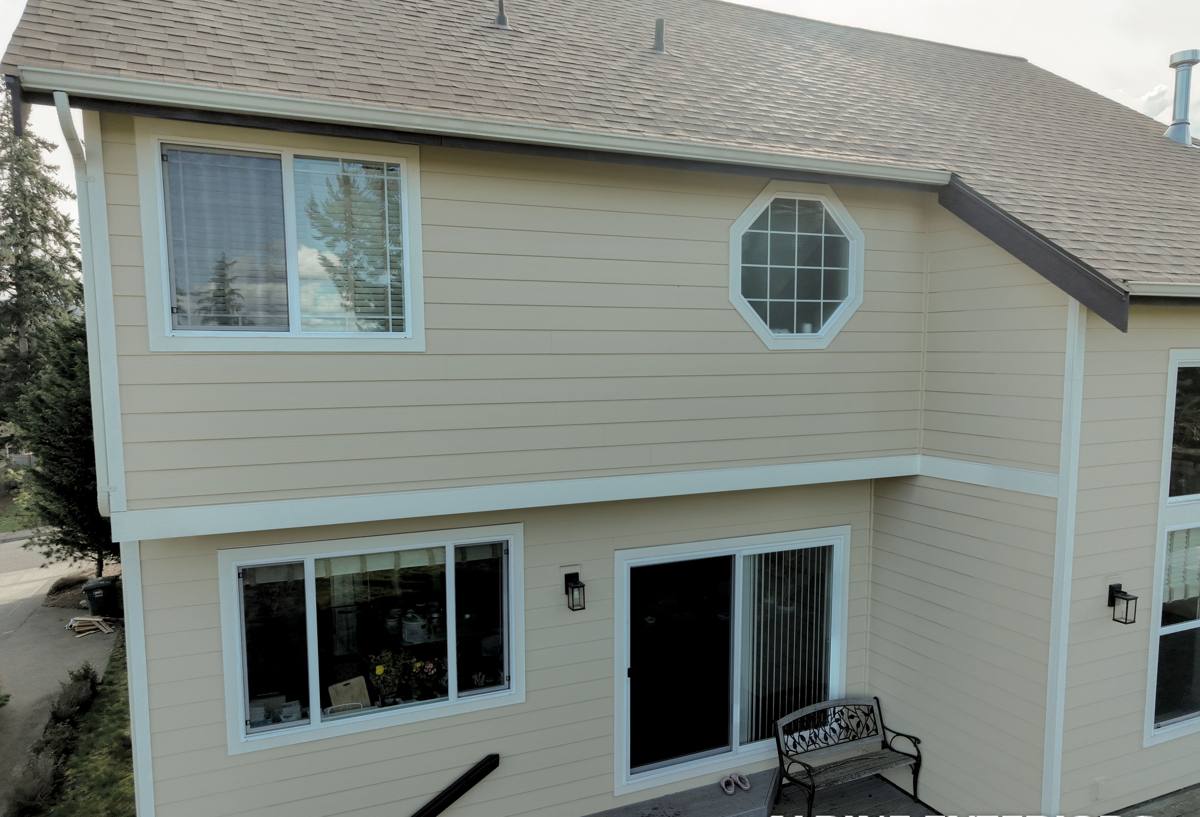
Signs Your Siding Has Reached the End of the Road
Replacement makes sense when the damage is structural or widespread — not when a single panel is dinged. Here's what tells us a home needs a full re-side rather than a repair:
- Soft or spongy spots when you press on the siding, especially near the bottom courses and around windows
- Visible cupping, warping, or buckling across multiple panels or boards
- Paint that's peeling, bubbling, or chalking heavily rather than just faded
- Rust streaks running down from nail heads or trim fasteners
- Gaps opening up at seams, corners, or where siding meets trim
- Visible mold or mildew staining that keeps coming back after cleaning
- Interior signs — stained drywall, musty smell, or peeling interior paint on exterior walls — that point to moisture getting through the wall assembly
- Siding that's more than 20-25 years old and made of a moisture-sensitive material like untreated wood, primed spruce, or an early-generation composite
If you're only seeing one or two of these in an isolated area, a repair might be the right call. When several show up together, or when we find soft sheathing once we open a wall up, replacement is usually the more honest recommendation — patching a compromised wall system just delays a bigger repair later.
What a Proper Siding Replacement Actually Involves
A siding replacement is not just swapping old panels for new ones. Done correctly, it's a full rebuild of the wall's weather barrier, and the sequence matters:
Full Tear-Off and Inspection
We remove the existing siding down to the sheathing. This is the point where hidden problems surface — soft plywood or OSB, rot around window and door openings, and old flashing that was never installed correctly. Any compromised sheathing gets replaced before anything new goes up; covering over damaged wood just hides the problem for another owner to find later.
Moisture Barrier and Flashing
A new weather-resistant barrier goes on the sheathing, with proper flashing at every window, door, and penetration. In a wind-driven rain environment like Clearwater Beach, flashing details around openings are often the single biggest factor in whether a wall stays dry over the next twenty years.
Correct Fastening and Clearances
Fiber cement siding has specific nailing patterns, fastener types, and clearance requirements — including keeping the bottom edge above grade, decks, and roof lines by the manufacturer's minimum distance. Skipping these details is how houses end up with rot problems five years after a "new" siding job.
Trim, Caulking, and Finish Details
Corners, trim boards, and butt joints get sealed with the correct sealants for the material, and factory-finished panels get touched up with matching paint only where the manufacturer allows it — not repainted wholesale, which would void a factory finish warranty.
Choosing the Right Material for a Barrier Island
We get asked to bid against vinyl, wood, and LP SmartSide fairly often on Clearwater Beach jobs. Here's an honest look at how these materials tend to perform in this specific environment:
| Material | Salt air / moisture | Wind performance | UV / color retention | Long-term maintenance |
|---|---|---|---|---|
| Vinyl siding | Doesn't corrode, but can become brittle over time | Lower wind ratings; can crack or blow off in high gusts | Fades and chalks noticeably in intense coastal sun | Low upkeep but limited repair options once faded or cracked |
| Untreated wood / cedar | Absorbs moisture readily; vulnerable to rot near salt air | Depends on install quality; no inherent wind advantage | Requires repainting or staining on a regular cycle | Highest ongoing maintenance of the group |
| LP SmartSide (engineered wood) | Engineered to resist moisture better than raw wood, but edges and cuts are still moisture-sensitive if not sealed properly | Reasonable when installed to spec | Factory finish holds up reasonably well but is sensitive to installation errors | Moderate; installation quality matters a great deal |
| James Hardie fiber cement (HZ5) | Non-combustible, engineered specifically for high-humidity, moisture-prone climates | Rated for high wind zones when installed per spec | ColorPlus factory finish is baked on and warrantied against fading and peeling | Low; no rot, and finish is warrantied rather than dependent on repainting cycles |
This isn't to say every product in that table is a bad product — vinyl and engineered wood both have legitimate uses. But for a home taking direct salt air and storm exposure on a barrier island, the trade-offs on moisture behavior and long-term maintenance are why we made a standardizing decision as a company.
Why We Only Install James Hardie
We install James Hardie fiber cement siding exclusively — we don't offer vinyl, LP SmartSide, Cemplank, Allura, primed spruce, or cedar as alternatives. That's a deliberate standard, not a sales limitation. Fiber cement is non-combustible, dimensionally stable in humidity swings, and doesn't feed rot or termites the way wood-based products can. For Clearwater Beach specifically, we typically spec Hardie's HZ5 product line, which is engineered for high-humidity, high-moisture climates like ours — as opposed to the HZ10 line built for drier, colder regions. The factory-applied ColorPlus finish is baked on under controlled conditions rather than field-painted, which is a meaningful advantage in a spot where UV and salt air are both working against paint adhesion year-round. Hardie also backs its products with a strong transferable warranty, which matters on a barrier island where a lot of properties change hands or get used as rentals.
Our Process, Start to Finish
- On-site assessment. We walk the exterior, check for soft spots, and look at trim, flashing, and any areas showing early moisture damage.
- Written estimate. You get a clear scope covering tear-off, sheathing repair contingencies, product line and color, and timeline — no vague allowances.
- Material order and scheduling. Hardie panels and trim are ordered to spec for the job, factoring in Gulf-side weather windows.
- Tear-off and sheathing inspection. Old siding comes off, and any compromised wood is addressed before moving forward.
- Weather barrier, flashing, and installation. Panels go up per manufacturer fastening and clearance requirements.
- Final walkthrough. We go over the finished job with you before calling it complete.
What Drives the Cost of a Siding Replacement
Every Clearwater Beach home is different, so we don't quote a number without seeing the property, but these are the factors that move the price most:
| Factor | Why it matters |
|---|---|
| Square footage and home height | More surface area and multi-story access both add labor time |
| Condition of existing sheathing | Rotted or soft plywood found during tear-off needs to be replaced before new siding goes on |
| Trim and architectural detail | Homes with more corners, dormers, or decorative trim take longer to flash and finish correctly |
| Product line and profile | HZ5 lap siding, shingle-style panels, and board-and-batten profiles carry different material costs |
| Access and site logistics | Narrow lots, elevated beach homes, and limited staging space common on the island can add time |
| Color and finish selection | Standard ColorPlus colors versus custom or premium finishes affect material pricing |
Why Local Experience on the Island Matters
A crew that regularly works Clearwater Beach knows things that don't show up on a spec sheet: how elevated and stilted beach homes change access and staging, how tight some lots are for material delivery and dumpster placement, and what wind and moisture exposure actually does to a wall assembly on this specific stretch of coastline versus an inland Pinellas County neighborhood. That experience shows up in the details — flashing choices, fastener selection, and knowing which areas of a home take the worst of the wind-driven rain and need the most attention. It also means fewer surprises with permitting and inspection timing, since local building requirements for wind resistance and coastal construction are something we deal with regularly rather than looking up for the first time.
Ready to Talk About Your Siding?
If your Clearwater Beach home is showing any of the warning signs above, or you're just planning ahead for a property that's due, we're happy to take a look and give you a straight assessment — no pressure, no upsell. Fill out the form below for a free estimate and we'll walk the property with you in person.